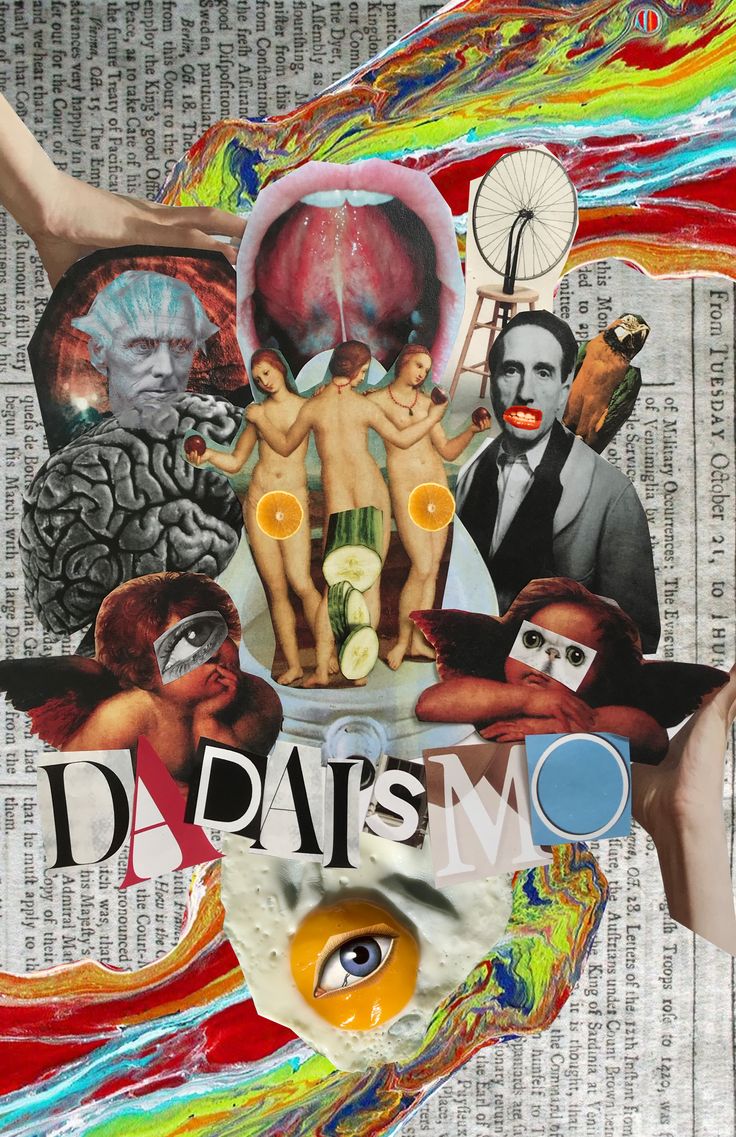
| The anarchic artistic and literary movement known as Dada—characterized by randomness, nihilism, and a sort of destructive playfulness—was founded in 1916, in Zurich, as a direct response to World War I. “We were seeking an art based on fundamentals, to cure the madness of the age, and a new order of things that would restore the balance between heaven and hell,” wrote the German sculptor Hans Arp. “We had a dim premonition that power-mad gangsters would one day use art itself as a way of deadening men’s mind.” (Good thing that never happened, right? Right?) “These days, the Dadaists usually get clumped together with the Surrealists, if they come up at all,” writes Benjamin Aleshire. “Though often reduced to nothing more than oddly dressed absurdists, Tristan Tzara and the Dadaists were bent on waging an insurgent cultural campaign of anti-art. . . . Their bizarre poems and art were part of an explicitly anti-colonialist attempt to provoke the bourgeoise into destroying Capitalism, beginning with the false rationalism it depends upon. If the bodies stacking up in heaps in WWI could be rational, well, the Dadaists would stop making sense.” So perhaps it’s appropriate that no one really knows how the movement got its name. German playwright Hugo Ball has some claim to it—he founded a magazine with the name in 1916. But the most widely repeated story is that it was Romanian poet Tristan Tzara, who opened a dictionary at random and blindly stabbed at a word (with either a finger or a knife, depending on the storyteller), and that word was Dada, French for “hobby horse.” The poet Richard Huelsenbeck recalled the dictionary, but not Tzara, nor the randomness, writing “the word Dada was accidentally discovered by Ball and myself in a German-French dictionary when we were looking for a stage-name for Madame Le Roy, the singer in our cabaret.” It’s also, of course, Russian and Romanian for “yes yes,” and others have written that they assumed this was the origin of the phrase—after all, it would be fitting for a movement so allergic to boundaries. Tzara himself claimed not to know how the name was settled on. He also, famously, declared that Dada ne signifie rien (“Dada means nothing”), so interpret that as you will. But how about this: “I hereby declare that Tzara invented the word Dada on 6th February 1916, at 6 p.m.,” wrote Hans Arp in 1921. There, that’s clear enough! Except this is how he continues: “I was there with my 12 children when Tzara uttered the word . . . it happened in the Café de la Terrasse in Zurich, and I was wearing a brioche in my left nostril.” How very Dada. |



 The Haunted Typewriter - Homepage of St. Louis Author Cypress Butane
Leave a comment